
Abstract
This paper examines the integration of artificial intelligence (AI) within enterprise resource planning (ERP) systems, with a particular focus on intelligent comparison and anomaly detection in Accounts Payable (AP) operations. The study demonstrates how AI applications, such as those leveraging the ChatGPT 4.1 API, can automate the comparison between vendor master databases and invoice records to identify inconsistencies, missing data, and potential duplications. By focusing on vendor attributes such as name, tax identification number, address, and template structure, the system enhances data quality and process efficiency. Moreover, this research highlights how AI-enabled ERP systems promote operational scalability, reduce manual intervention, and support strategic decision making. The findings underline that integrating AI-driven anomaly detection transforms AP management from a reactive process into a predictive, data-intelligent financial function.
Introduction
The financial operations landscape has experienced a profound transformation in recent years, primarily driven by the rapid advancement of artificial intelligence (AI) technologies. Organisations increasingly recognise the importance of digitalisation and automation as essential strategies for maintaining financial accuracy, enhancing operational efficiency, and ensuring compliance with regulatory standards. According to the Ramp AI Index, the adoption of AI solutions among large enterprises has nearly doubled within the past year, with more than half now integrating such tools into their operations [1].
Despite this progress, traditional enterprise resource planning (ERP) systems continue to face limitations in addressing the complex data challenges inherent in accounts payable (AP) processes. The Institute of Financial Operations & Leadership (IFOL) 2023 Survey Report revealed that 56% of AP teams spend over ten hours per week on manual invoice processing, while 41% dedicate significant time to managing supplier payments and account details [2]. Manual invoice verification and vendor master data inconsistencies remain critical obstacles, particularly when invoice data must be manually cross-checked against vendor databases—a process that is both time-consuming and prone to human error.
At the same time, many finance teams remain in the early, exploratory stages of AI adoption, using tools such as ChatGPT to draft communications or employing Copilot to summarise documents. This measured and cautious approach is largely influenced by the complexity of manual financial workflows and the high sensitivity of financial data, which makes organisations reluctant to share critical information with external AI systems. A 2024 survey conducted by Deloitte and the Institute of Management Accountants (IMA) involving more than 900 finance and accounting professionals found that only 9% are currently using generative AI, while an additional 8% are in the early phases of adoption [3].
Although the adoption of AI in finance remains gradual, the potential benefits are substantial. Emerging AI technologies have demonstrated strong capabilities in automating repetitive accounting tasks, detecting anomalies within large datasets, and improving decision accuracy through predictive analytics. Integrating AI with ERP platforms allows organisations to shift from reactive financial management to proactive and data-driven strategies. Moreover, AI’s capacity to analyse historical invoices and vendor data provides valuable insights for reducing errors, enhancing compliance, and preventing fraud.
This paper explores how AI can convert these persistent challenges into strategic advantages by leveraging intelligent automation, advanced data analytics, and cognitive decision-making to transform the efficiency and accuracy of financial operations.
Limitations of Traditional Accounts Payable Processes
A foundational constraint of conventional accounts-payable workflows is their inadequate capacity to maintain high invoice-quality standards at scale. Invoice quality—understood as the completeness, accuracy, and consistency of invoice data—is a critical determinant of financial performance, timely payments, and supplier relationship health. When invoices contain missing or inaccurate data (e.g., incorrect vendor names, missing purchase‐order references, mis-stated amounts), downstream manual interventions proliferate: time is spent investigating, validating, and routing exceptions rather than progressing routine payments.
Compounding this challenge, many organisations struggle to ensure coherence between invoice data and the vendor master database. The vendor master record—containing information such as vendor name, address, bank details, payment terms, tax identifiers and internal vendor code—is meant to serve as the authoritative “single source of truth” for processing. Yet when an invoice fails to align with the vendor master file (for example, the vendor number is incorrect, input data differs, or the vendor is not yet registered), the AP process stalls: manual review becomes required, automatic matching fails, and the risk of duplicate payments or erroneous liability recognition increases. Research has shown that poor vendor-master quality underpins inefficient AP operations, with some reports indicating that nearly 30% of duplicate payment incidents originate from flawed vendor master data [4].
Furthermore, traditional AP systems are ill-equipped to scale in the face of volume growth while maintaining invoice-quality integrity. Nearly 95% of surveyed organisations reported an increase in monthly payable volumes over the prior year, and 93% expect further growth. Yet only 47% believe they could cope effectively with a 50% volume increase under current practices. This disparity signals that manual processing is rapidly approaching operational saturation [5]. In such environments, invoice exceptions mount, vendor-data inconsistencies multiply, and processing velocity declines—often resulting in late payments, missed discounts, strained vendor relationships, and compliance vulnerabilities.
In addition, the fragmented nature of manual AP operations—characterised by disparate invoice types, non-standard formats, and inconsistent data capture—further erodes control over quality. Without robust vendor-master governance and stringent invoice-data validation rules, organisations face significant risks: misstated liabilities on the balance sheet, mis-classified expenses, audit failures, and missed regulatory obligations [6].
AI Integration in ERP System for Improve AP Processing
The integration of artificial intelligence within enterprise resource planning systems represents a major step forward in addressing the long-standing inefficiencies of traditional accounts payable operations. As organisations transition toward intelligent finance ecosystems, AI-enabled ERP systems offer advanced capabilities for automating invoice validation, enhancing vendor data management, and optimising end-to-end AP workflows.
According to McKinsey & Company’s The State of AI 2025 report, 88 percent of surveyed organisations have incorporated AI into at least one business function, but only about one-third have scaled its use across the enterprise. High-performing companies are characterised by embedding AI deeply within core financial processes and redesigning workflows around data-driven intelligence rather than relying solely on automation [8].
Within the AP context, AI integration allows ERP systems to automate three key pain-points: invoice data capture, exception handling, and vendor-master reconciliation. Using machine learning (ML) and optical character recognition (OCR), AI-enabled modules extract and structure data from invoices, classify them according to company-specific coding rules, and automatically match them against purchase orders records. When mismatches occur—such as discrepancies between invoice details—the AI system flags these for review or autonomously suggests corrections based on learned patterns. This intelligent reconciliation process significantly improves invoice quality, accuracy, and approval speed while reducing the manual interventions that historically slowed payment cycles.
The capacity to process both current and historical invoices offers additional advantages. By analysing multi-year invoice archives, AI models can identify recurring discrepancies, duplicate payments, and potential fraud signals. For example, research by Apex Analytix found that nearly 30 percent of duplicate payments uncovered in one company were triggered by vendor-master data errors [9]. Moreover, predictive analytics embedded in ERP platforms help finance teams forecast payment bottlenecks and optimise working-capital allocation.
AI’s influence extends beyond automation toward strategic insight. High-performing organisations are nearly three times more likely to have redesigned their workflows to embed AI decision-loops. This shift means that AP processes are no longer viewed merely as operational back-office tasks, but as dynamic intelligence systems generating actionable insights about spending patterns, supplier performance, and compliance risk. Such integration enables a proactive AP function—capable of self-auditing transactions, prioritising vendor payments based on financial exposure, and adapting automatically to policy or regulatory changes.
Nonetheless, successful integration depends on effective change management and data governance. AI cannot operate effectively without consistent, high-quality data pipelines. Studies emphasises that “human-in-the-loop” validation remains critical for ensuring model accuracy, particularly in financial-reporting environments where errors have compliance implications [8]. Therefore, a hybrid model combining AI automation with human oversight represents the most effective pathway for sustainable AP transformation.
Intelligent Comparison and Anomaly Detection
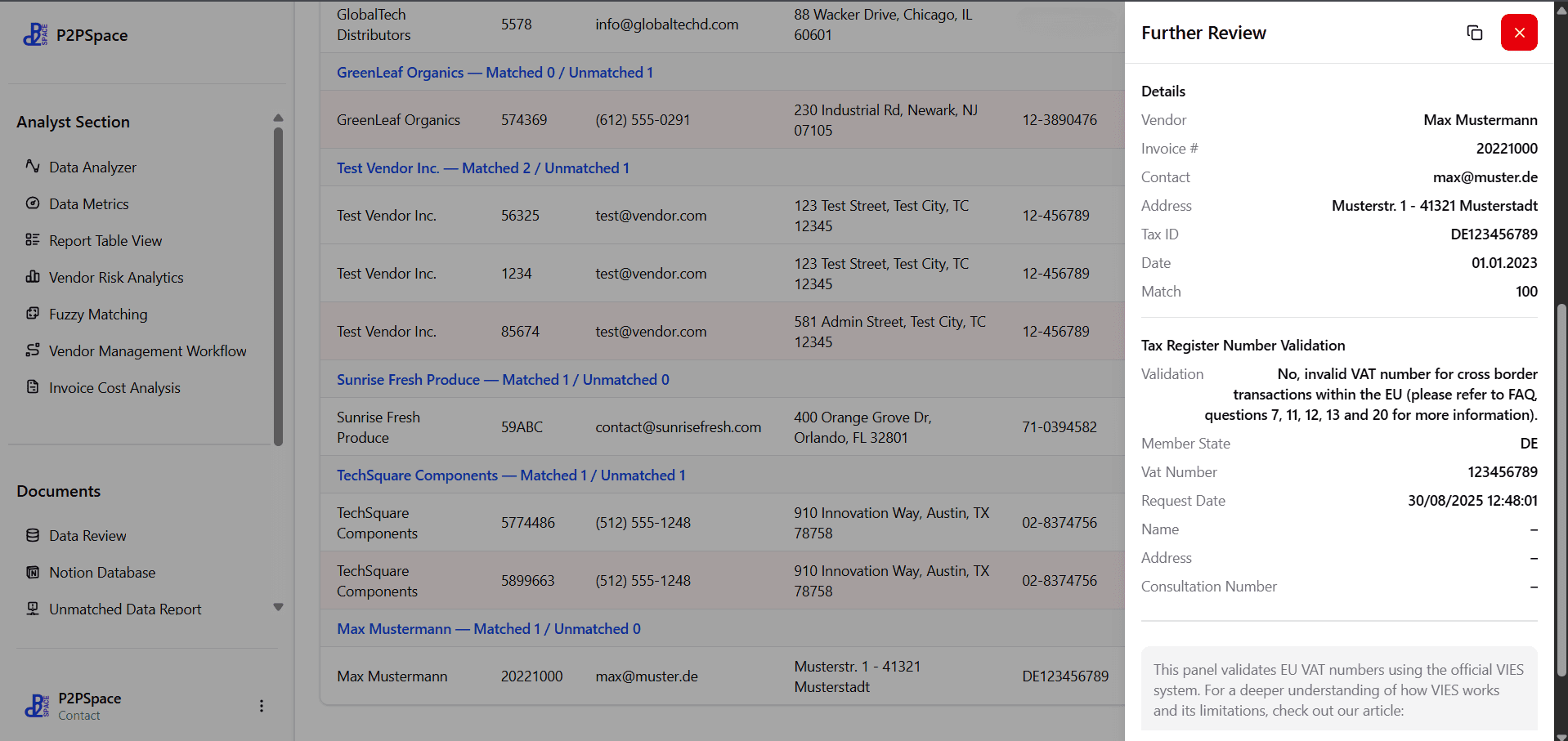
Recent developments in applied artificial intelligence have redefined the analytical capabilities of ERP systems, particularly in the context of accounts payable management and data governance. Among the most consequential innovations is the application of intelligent comparison frameworks, which enable AI-driven systems to autonomously evaluate the consistency and reliability of data between vendor master records and invoice submissions. The AI application developed for this study exemplifies this innovation, employing the ChatGPT 4.1 API as its core analytical engine. The system ingests and interprets information extracted from both PDF and Excel formats, performing comparative analyses that classify records into three categories—matched, unmatched, and semi-matched—to provide a structured summary of data integrity. This three categorical classification supports finance professionals in assessing supplier reliability and identifying transactional discrepancies with enhanced speed and precision.
Unlike conventional invoice-matching systems that prioritise numerical validation (such as invoice amounts, dates, bill to address or purchase-order references), the proposed AI framework adopts a semantic and identity-driven approach. It focuses on critical vendor-specific attributes—vendor name, tax identification number, address, contact details, and document template structure—thereby addressing qualitative inconsistencies that often elude rule-based automation. The system also conducts retrospective analyses across historical invoice archives, identifying patterns of recurring discrepancies between vendor master data and prior invoice entries. This longitudinal analytical capability enables the detection of systemic data-quality issues, such as recurring vendor-record deviations or duplicate registration, thereby enhancing both the accuracy and governance of financial datasets.
From a technical standpoint, the ChatGPT 4.1 API offers a robust linguistic and contextual reasoning foundation for document interpretation. Its extended context window facilitates comprehensive analysis of unstructured invoice content, while its generative reasoning architecture supports adaptive summarisation and anomaly identification. In comparative evaluation, APIs such as Google’s Gemini and Anthropic’s Claude offer alternative trade-offs in cost efficiency and computational performance. As of 2025, Google’s Gemini Flash-Lite model is priced at approximately US $0.075 per one million input tokens and US $0.30 per one million output tokens, whereas Anthropic’s Claude Opus model incurs costs of roughly US $15 per one million input tokens and US $75 per one million output tokens. These discrepancies underscore that model selection in enterprise AI deployments must consider not only accuracy and reasoning capability but also token efficiency, scalability economics, and data-privacy constraints (Google AI, 2025; Anthropic, 2025).
For a standard workflow—comprising the extraction, comparison, and summarisation of one Excel file (~50,000 tokens) and two PDF files (~100,000 tokens)—total token consumption is estimated at approximately 180,000 tokens. Based on current pricing structures, the cost differentials are significant:
Gemini Flash-Lite: Input ≈ 0.15 M × $0.075 = $0.0113; Output ≈ 0.03 M × $0.30 = $0.009; Total ≈ $0.020 USD.
Claude Opus: Input ≈ 0.15 M × $15 = $2.25; Output ≈ 0.03 M × $75 = $2.25; Total ≈ $4.50 USD.
ChatGPT 4.1: At an estimated rate of $30 per 1 M input tokens and $60 per 1 M output tokens, Input ≈ $4.50; Output ≈ $1.80; Total ≈ $6.30 USD.
These comparisons demonstrate that low-cost APIs such as Gemini Flash-Lite provide exceptional economic efficiency for smaller workloads, albeit with limited reasoning depth and context retention. Conversely, premium models such as Claude Opus and ChatGPT 4.1 deliver superior semantic comprehension and anomaly-detection reliability—qualities that may justify higher operational expenditure in enterprise environments where data accuracy, vendor-reconciliation fidelity, and compliance assurance are strategically critical. Thus, model selection for AP automation should be guided by a balanced assessment of computational capacity, financial constraints, and governance requirements.
The integration of intelligent comparison and anomaly-detection capabilities represents more than an operational enhancement; it signals the emergence of cognitive ERP systems capable of adaptive learning and predictive reasoning. By embedding AI models that continuously refine vendor-data relationships and anomaly patterns, the ERP ecosystem evolves from static data processing to dynamic financial cognition—a system that not only identifies discrepancies but anticipates them before they manifest operationally. Through this transition, accounts-payable management becomes an active participant in organisational intelligence, providing decision-makers with predictive insights on supplier reliability, data integrity, and potential compliance risk.
In this regard, the AI system presented here functions as a prototype for next-generation financial analytics, demonstrating how generative and comparative AI architectures can operationalise predictive governance within ERP infrastructures. By merging automation with contextual reasoning, it establishes a foundational model for intelligent, scalable, and self-improving financial systems—marking a pivotal step toward the realisation of fully autonomous, data-driven financial operations in the era of AI-enabled enterprise management.
Challenges and Benefits for Organisational Impact
The deployment of intelligent comparison and anomaly-detection mechanisms within enterprise resource planning (ERP) environments presents both strategic opportunities and significant implementation challenges. While these systems have the potential to redefine financial accuracy and operational agility, their success is contingent upon careful alignment between technological capability, organisational readiness, and governance maturity.
Challenges
A foremost challenge relates to data governance and quality assurance. The efficacy of anomaly-detection models is inherently dependent on the integrity and completeness of vendor master data. Inaccurate, duplicated, or outdated supplier information can propagate false positives or obscure genuine anomalies, thereby diminishing trust in AI outputs. Furthermore, legacy ERP infrastructures often operate with fragmented data silos that inhibit seamless AI integration. The migration and cleansing of historical data from these systems require extensive human validation, which can slow implementation and increase transition costs.
A second challenge concerns model transparency and interpretability. Deep-learning models, particularly those based on large language models (LLMs), can produce highly accurate results yet often lack explainability in their decision-making processes. In financial contexts—where accountability and audit-ability are paramount—this “black-box” nature poses compliance risks. Finance professionals and auditors must be able to trace how anomaly classifications (e.g., matched, unmatched, semi-matched) are derived to ensure they align with established accounting principles and regulatory requirements.
Third, ethical and regulatory considerations present an additional layer of complexity. The use of third-party APIs (e.g., ChatGPT 4.1, Gemini, and Claude) raises legitimate concerns regarding data privacy, confidentiality, and cross-border information flows. Sensitive vendor data transmitted to external APIs must comply with data-protection regulations such as the General Data Protection Regulation (GDPR) and ISO 27001 standards. Failure to manage these risks may expose organisations to legal liabilities or reputational damage.
Finally, human and cultural adaptation remains a critical barrier. Integrating AI into core financial processes requires a paradigm shift from procedural control to probabilistic reasoning. Many financial professionals exhibit resistance to algorithmic decision-making due to perceived threats to autonomy or accountability. Consequently, successful adoption depends not only on technical integration but also on cultivating AI literacy, trust, and human-in-the-loop frameworks that ensure oversight without undermining efficiency.
Benefits
Despite these challenges, the organisational benefits of intelligent comparison and anomaly detection are substantial and multidimensional. At an operational level, AI-enabled ERP systems deliver significant improvements in invoice accuracy, process speed, and error detection. Automated data reconciliation reduces manual workload, freeing finance teams to focus on strategic analysis and supplier relationship management. By classifying transactions in real time and identifying discrepancies proactively, organisations can prevent costly errors such as duplicate payments, unapproved vendor creation, or fraudulent invoices.
At a strategic level, these systems enhance data-driven decision-making. The continuous monitoring and cross-referencing of vendor master data with historical invoice patterns provide actionable insights into supplier performance, compliance trends, and spending behaviour. These insights enable financial leaders to make predictive decisions about cash flow, procurement efficiency, and risk exposure—thereby shifting the accounts payable (AP) function from a transactional service to a strategic intelligence hub.
In addition, the integration of anomaly detection fosters audit-ability and regulatory compliance. AI systems can maintain immutable records of detected discrepancies, including timestamped explanations of flagged transactions, thereby simplifying audit trails and reinforcing financial transparency. Such automation reduces the likelihood of human error while supporting the stringent documentation requirements of internal and external audits.
Finally, the long-term organisational impact extends to cognitive transformation and scalability. As AI systems continuously learn from historical invoice data and vendor behaviour, they evolve into adaptive cognitive infrastructures capable of anticipating anomalies before they occur. This predictive capability enhances enterprise resilience, allowing organisations to manage financial complexity dynamically while maintaining accuracy and governance across expanding operational scales.
In summary, while intelligent comparison and anomaly-detection systems introduce challenges in data integrity, interpretability, and organisational adaptation, their successful implementation can generate transformative benefits. By embedding AI-driven comparison and predictive anomaly analytics into ERP systems, organisations achieve not only operational efficiency but also a fundamental shift toward intelligent financial ecosystems—where data accuracy, transparency, and foresight become enduring sources of competitive advantage.
Conclusion
This study review concludes that AI-powered intelligent comparison and anomaly detection represent a pivotal advancement in financial automation and data governance. By embedding AI models within ERP infrastructures, organisations can significantly enhance the accuracy, transparency, and efficiency of their accounts payable processes. The adoption of these systems enables real-time vendor-data validation, proactive error detection, and improved compliance control. While challenges related to data governance, ethical considerations, and workforce adaptation persist, the long-term benefits of predictive analytics and operational agility outweigh transitional complexities. Ultimately, the integration of AI within ERP systems signals a shift toward cognitive finance—a future where systems continuously learn, adapt, and optimise to strengthen organisational intelligence and decision-making capacity.
Referance
1. Ramp. (n.d.). Ramp AI Index – Monthly measurement of AI adoption by American businesses.Ramp Economics Lab. Retrieved 10/10/2025, from https://ramp.com/data/ai-index
2. Institute of Financial Operations & Leadership. (n.d.). Accounts payable automation trends 2023. IFOL. https://acarp-edu.org/accounts-payable-automation-trends-2023/
3. Deloitte, & Institute of Management Accountants. (2024). Next-gen controllership: Harnessing AI and emerging technologies to transform finance and accounting. Institute of Management Accountants. https://www.imanet.org/en/Research-Publications/IMA-Reports/Next-Gen-Controllership-Harnessing AI-and-Emerging-Technologies-to-Transform-Finance-and-Accounting
4. VendorInfo. (n.d.). Vendor master management: Access and best practices for data quality. VendorInfo. https://vendorinfo.com/vendor-master-management-access/
5. PYMNTS. (2023, May 8). Leveraging digitization and automation to improve AP. PYMNTS.com. https://www.pymnts.com/accounts-payable/2023/pymnts-intelligence-leveraging-digitization-and-automation-to-improve-ap/
6. FasterCapital. (2024). The impact of inaccurate vendor master data on financial reporting. https://fastercapital.com/topics/the-impact-of-inaccurate-vendor-master-data-on-financial-reporting.html
7. McKinsey & Company. (2025, November). The state of AI 2025: Agents, innovation, and transformation. QuantumBlack, AI by McKinsey. https://www.mckinsey.com/capabilities/quantumblack/our-insights/the-state-of-ai-2025
8. Apex Analytix. (2023). 3 big financial benefits of a clean vendor master. Apex Analytix. https://www.apexanalytix.com/resources/reports/3-big-financial-benefits-of-a-clean-vendor-master/
9. Anthropic. (2024, March). Introducing Claude 3: The next generation of AI assistants.Anthropic. https://www.anthropic.com/news/claude-3
10. Google DeepMind. (2024, April). Gemini 1.5 technical report. Google DeepMind. https://deepmind.google/discover/blog/google-deepmind-gemini-1-5/
11. OpenAI. (2024, November). GPT-4 technical report. OpenAI. https://cdn.openai.com/papers/gpt-4.pdf
12. OpenAI. (2025, April). ChatGPT 4.1: Advancing reasoning and multimodal understanding. OpenAI. https://openai.com/research/chatgpt-4-1
13. Google AI. (2025). Gemini API pricing [Web page]. Google AI for Developers. https://ai.google.dev/gemini-api/docs/pricing
14. Anthropic. (2025). Pricing – Claude API [Web page]. Anthropic. https://docs.anthropic.com/en/docs/about-claude/pricing
15. European Union. (2016). Regulation (EU) 2016/679 of the European Parliament and of the Council of 27 April 2016 on the protection of natural persons with regard to the processing of personal data and on the free movement of such data (General Data Protection Regulation). Official Journal of the European Union. https://eur-lex.europa.eu/eli/reg/2016/679/oj
14. International Organization for Standardization. (2022). ISO/IEC 27001:2022 – Information security, cybersecurity and privacy protection — Information security management systems —Requirements. ISO. https://www.iso.org/standard/82875.html
Stay Informed with P2P Space Blog
Explore Insights, Tips, and Inspiration
Dive into amazing blogs, where we share valuable insights, tips, and inspirational stories on procurement to pay, AI, life, and more. Stay informed, get inspired, and enrich your journey with P2P Space.